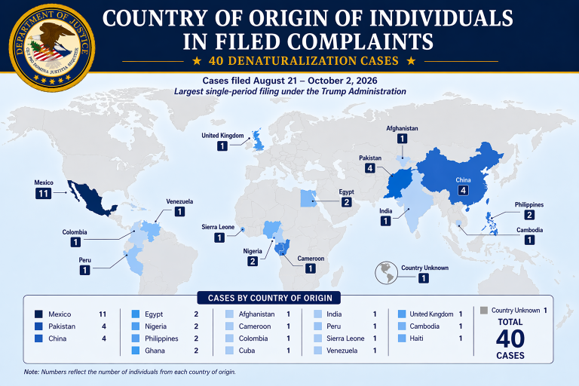
Under the Immigration and Nationality Act (INA), the government may seek to revoke a naturalized citizen’s citizenship and cancel the person’s Certificate of Naturalization if citizenship was illegally procured or obtained through concealment of a material fact or willful misrepresentation during the naturalization process.
The cases announced by the Justice Department involve a wide range of alleged offenses, including identity and immigration fraud, sham marriages, concealment of criminal records, sexual offenses against children, tax and financial fraud, and acting as an agent of a foreign government.
Among those named is Chinese national Jinchao Wei, who is accused of collecting and selling U.S. military secrets on behalf of the Chinese government after joining the U.S. Navy. He was convicted in 2025 on espionage-related charges, and the Justice Department is now seeking to revoke his U.S. citizenship.

Another Chinese national, 61-year-old Ping Li, is accused of working for China’s Ministry of State Security (MSS) for years. According to the Justice Department, beginning around 2012, Li followed instructions from Chinese intelligence officers to collect information on Chinese dissidents, pro-democracy activists, members of the Falun Gong movement, and U.S.-based nongovernmental organizations, and provided the information to the Chinese government. He is also accused of obtaining sensitive information from his employers, including a major U.S. telecommunications company and an international information technology company. In August 2024, Li pleaded guilty to acting as an agent of the Chinese government without prior notification to the U.S. Attorney General. The Justice Department is now seeking to revoke his naturalized citizenship.
In March, a U.S. court also revoked the citizenship of another Chinese-born couple, Li Chen and Yu Zhou, after determining that their involvement in wire fraud and theft of trade secrets meant they did not meet the “good moral character” requirement for naturalization.

U.S. court also revoked the citizenship of another Chinese-born couple, Li Chen and Yu Zhou.(U.S. Attorney’s Office)
Some of the cases involve serious sexual offenses. For example, Cuban-born Javier Marrero-Pando is accused of concealing during his naturalization process that he had committed aggravated sodomy against a man with special needs. He was ultimately sentenced to life in prison, with all but 15 years suspended. Mexican-born Ramiro Escot Esparza is accused of concealing multiple acts of sexual abuse against a minor and pleaded guilty to related offenses several months after obtaining citizenship. Several other defendants are accused of sexually abusing children or minors before naturalization and denying or concealing those crimes during their citizenship applications and interviews.
Other cases involve identity theft and fraud, the use of false names or birth certificates, fraudulent marriages, visa and green-card fraud, tax evasion, money laundering, securities fraud, and concealment of previous deportation orders. Some defendants allegedly used false identities for years before obtaining citizenship, while others allegedly fabricated a spouse’s death or divorce to obtain immigration benefits. Some also swore during naturalization interviews that they had never committed crimes, only to have those crimes later come to light.
Attorney General Todd Blanche described the action as the “largest denaturalization effort in modern history” and said the government would continue using denaturalization proceedings to protect national security and public safety.
Assistant Attorney General Brett A. Shumate of the Justice Department’s Civil Division said the government’s position is that the defendants obtained U.S. citizenship through deception and that the department will continue pursuing such cases to protect the integrity of the U.S. citizenship system.
It is important to note that the allegations in these lawsuits are claims made by the government only, and the courts have not yet issued final determinations of liability or wrongdoing in these cases.